
Release time: 2025-05-23 Number of views: 1688
When designing embedded systems, selecting the right method to connect a System on Module(SoM) to a carrier board is essential. The two most common approaches are castellated pads and edge connectors. Each offers unique benefits depending on your project's design goals.
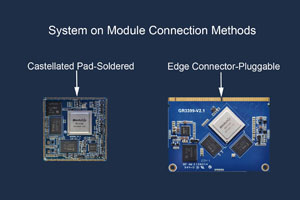
Castellated pads are semi-plated, surface-mount pads located around the edges of a SoM. These are designed to be permanently soldered to the baseboard using SMT reflow soldering.
Compact and rugged—ideal for industrial environments
Lower cost in high-volume production
Provides strong mechanical and electrical connection
Edge connectors use gold-plated contact fingers that insert into a socket on the baseboard. This modular approach allows for easy replacement or upgrade of the SoM.
Hot-swappable and easy to service
Faster development turnaround for prototypes
Supports high-speed signal integrity
| Feature | Castellated Pad | Edge Connector |
|---|---|---|
| Connection Type | Soldered | Pluggable |
| Maintenance | Low (requires re-soldering) | High (hot-swappable) |
| Mechanical Strength | Very High | Moderate |
| Use Cases | Industrial systems, compact devices | Dev kits, modular systems |
If your application demands durability and low unit cost in large volumes, castellated pads may be ideal. If you prioritize flexibility and ease of maintenance, an edge connector is likely the better choice.
Looking for RK3399 SoMs with either interface? View our product lineup here.

Keep up with our evolving product features and technologies. Enter your email and subscribe to our newsletter.

Copyright © 2020 https://www.embsom.com/